Kat Wilkins
Your body is cool.

For the last two weeks my body has been in a bad asthma + allergy flare-up. I’ve had to sleep sitting up just in order to breathe at night. It’s made my pre-existing struggle with chronic fatigue even worse.
As I reflect now on the last two weeks (feeling so much better because steroids and Flonase), I’m reminded that my body is badass.
Yours is too. Yup, you heard me right. Your body is a super-cool amazing badass.
Hear me out:
That body of yours is wired for safety. As in, its single most important job is to keep you safe. And it’s so fiercely devoted to your survival—as in, once your body detects a threat, all its resources move immediately toward protecting you (whether that’s through mobilizing or immobilizing)—that it doesn’t differentiate between a physical threat and a psychological/emotional threat.
This means that when you’re experiencing an emotional or psychological threat, your body might act as if you’re literally about to be mauled by a tiger.
And that’s not crazy. In fact, it’s brilliant. Because in this, our bodies express the immense wisdom that:
Experiencing emotional or psychological harm is just as threatening as suffering physical harm.
No one knows this reality more than trauma survivors. We carry wounds that aren’t worn on our skin. The things we’ve had to survive don’t feel any less painful just because they might be invisible.
This is no way minimizes those of us who have experienced or are enduring physical danger. Any physical violence we suffer within our nation and elsewhere around the world is egregious and tragic.
And—
Your pain is just as valid if the harm done to you hasn’t borne physical scars or bruises.
My recent asthma flare wasn’t super obvious outwardly. Because of my decades-long history of asthma, I know my body and my symptoms enough to know that I was never actually in any danger of not-breathing (if I was, I’d have hustled myself to the ER or called 911). But for two weeks my body has been stuck in a mobilized, sympathetic nervous system state— “fight/flight,” because the threat my body was detecting was as if there were a literal life-threat of not getting enough oxygen to live. I could look at this as my body being broken or bad or stupid or over-reacting (and believe me, throughout my life I have done my fair share of this kind of body-hate toward myself).
But today, I choose to see it with gentleness, gratitude, and compassion. Because my body had been in such a threat-state for two weeks, I’ve felt exhausted and stressed—not because I was lazy or broken or bad, but because my good, fierce, strong little body was fighting so damn hard just to live. And I think that’s pretty amazing.
Your body is wired this way too. And if you feel crazy or broken or like your body is overreacting, may I say this to you:
I’m so sorry your body has had to work so hard to survive. I’m so sorry your body has had to be so resourceful through so much. I’m so sorry that your body has had to carry so much for so long. I choose to see the goodness in what your body is trying to do for you—what it has probably been working so hard for so many years to try to do.
Perhaps you can begin to bring a similar compassion to your own body’s story of safety and survival.

For those of you who want to understand your body’s brilliant protective capabilities further, here is an activity1 you can explore:
(Before I explain the activity, I’ll teach you a bit about Polyvagal Theory—the science of how we feel safe in relationships and environments. The aim of this exercise is to provide new awareness of what your system is sensing around you, and how that impacts your ability to connect safely to yourself, your environment, and others around you. I’m also hoping it gives you a new compassion and appreciation for the brilliant, resourceful ways your body has had to work to protect you. Because all healing must start with compassion.)
What is Polyvagal Theory?
Polyvagal Theory was founded by Dr. Stephen Porges in the late 1960s. Deb Dana is largely responsible for bringing its application to the therapy context, and in her book The Polyvagal Theory in Therapy, (which is the book I’m paraphrasing and quoting from for this post) Dana describes Polyvagal Theory (PVT) as "the science of safety": "the science of feeling safe enough to fall in love with life and take the risks of living. Polyvagal Theory provides a physiological and psychological understanding of how and why clients move through a continual cycle of mobilization, disconnection, and engagement" (emphasis mine).2
The Three Organizing Principles of Polyvagal Theory:
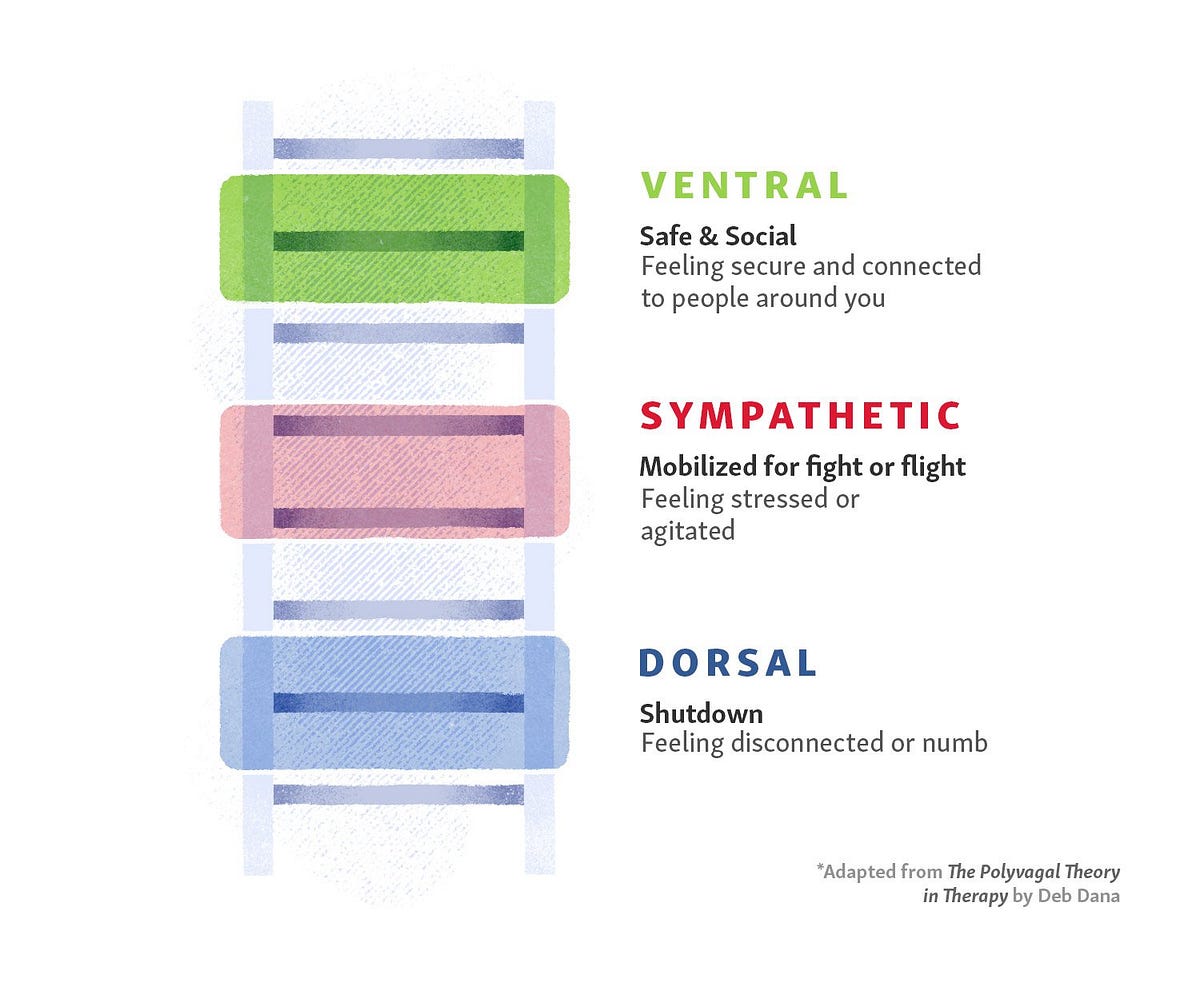
Hierarchy (aka the "ladder") - the autonomic nervous system responds to external/internal stimuli through three biological pathways, in a particular order, and is commonly demonstrated with a ladder image, as shown above. These three pathways are the dorsal vagus (immobilization), the sympathetic nervous system (mobilization), and the ventral vagus (social engagement and connection).3
Neuroception (aka what I call "magic antennae") - the term "neuroception" was coined by Stephen Porges, and refers to the ways our nervous system responds to safety cues and danger cues. It's like having magic antennae that are constantly scanning (6 times per second, actually) your "inside, outside, and between" (inside your body, the environment outside your body, and what's happening between you and other people). Different from perception, neuroception occurs deep underneath the conscious level of awareness.4
Coregulation - This describes the process by which a nervous system is reciprocally regulated (brought back to "safety") in the presence of a safe "other" (caregiver, parent, etc). PVT sees co-regulation as an imperative in a person's ability to sustain life through being enabled to move into safe relationships and meaningful connections.5
Personal Profile Map
Warning: Since this map includes specifics about your own nervous system states and responses, it is common for this to be a disruptive activity at times. I highly recommend doing this exercise with a trusted friend or therapist - but however you do it, please take some time to tune in to how you're doing. I strongly encourage you to take breaks as needed.
Now that we've covered the basics of Polyvagal Theory, let's consider an exercise of creating your own "personal profile map." When I do this with clients, we call it "mapping your nervous system."
It may be helpful to do some grounding for your system before you begin.
Let me invite you to take a deep breath in through your nose.
Hold that breath in for a few seconds.
Then, slowly exhale through your mouth.
Repeat as needed. (Feel free to skip any of this - you're in charge of your own body and how you move through this experience).
What we're attempting to do when we "regulate" or "ground" is to provide your system with as many safety cues as possible, as well as bringing your attention toward noticing those safety cues, and allowing your system to respond.
I invite you to take a few deep breaths before you begin. Take a moment to notice your breathing. Notice what the air feels like going in through your nostrils - notice the temperature.
Look around you in the space you're sitting in, and name out loud 5 items plus their color.
"The lamp is gold. There is a purple book next to me. The plant is green and brown. My shoes are gray. My chair is black."
When or if you're ready to move forward, let's begin.
Take a moment to draw a ladder like the one above, with 3 spaces. This is your nervous system map. As you move through the steps, feel free to be as creative as you want. You can write or draw with a pen or pencil, but I recommend that you use colored markers, as colors can evoke emotion and stimulate your system in a way that can add depth of meaning to the exercise.
As we cover each of the three spaces (in the order listed below), ask yourself these questions:
What emotions am I experiencing when I'm in this state? Eg. happy, scared, hopeless, sad, stressed, ashamed.
What thoughts might I have when I'm in this state? Eg. "I'm bad," "I'm ok," “It’s always going to be like this,” “No one likes me.”
What might my body be doing in this state? Eg. curled up in my bed, running around keeping busy, open/closed posture, crying.
When I'm in this state, how would I finish the sentence, "The world is _____?" (Eg. closing in on me, exciting, invisible)
When I'm in this state, how would I finish the sentence, "I am _____?" (Eg. unloveable, alone, not good enough, strong, stuck, free)
What physical landscape does this state feel like? (Eg. a cave, a sunny meadow, rapids, fog, tornado, beach)
What color does this state feel like?
What might my sleep/eating/substance use look like when I'm in this state?
THREE NERVOUS SYSTEM STATES (start with middle, then bottom, then top):
Sympathetic nervous system: Start in the middle of your ladder. Recall a time when you felt mobilized, like there was too much energy pulsing through you. You might feel overwhelmed, scared, worried, anxious. Consider this experience only long enough to let your body taste it enough to begin mapping it.
Dorsal vagal: Now go to the bottom of your ladder. Recall a time you felt disconnected, or a sense of collapse. Your system doesn't have enough energy to function, and might be shutting down. You might feel hopeless, distant, unmotivated, or a lack of interest. "Dip your toe" into this feeling just a bit, and then begin to map it.
Ventral vagal: Now move to the top of your ladder. Remember a time you felt a warm feeling of well-being. Perhaps it was just a moment, or a prolonged experience. The world feels safe enough, you feel ok enough, and are generally safe to connect to yourself and others. Let this feeling fill you now, and begin to map it.
Once you've completed your map, take a step back and take it all in.
Notice in this moment, what state are you in? We ended our exercise with the ventral vagal state (top of the ladder) on purpose - but is your body still in that state?
Perhaps it isn't. Perhaps your system has moved you back into immobilization—you're feeling unmotivated and alone. Or, perhaps you're back in the middle of your map—you're feeling the stress of the day, and your body is pulsing with anxiety or tension. If so, perhaps you can begin to notice what "danger cues" (real or perceived) your system might be responding to.
Wherever you're at, my hope is that you've learned a bit about your own nervous system today in a way that increases curiosity and compassion. Perhaps you move throughout your day with more awareness of the present moment. Let this invite you to respond to your nervous system without judgment. When you're dysregulated (in the middle or bottom of your map), this means your system is sensing danger of some sort. Perhaps you can be curious about the story your particular nervous system might be telling you, and what it might need in order to safely connect and engage in your world.
If you did this exercise and would be willing to let me know, I’d love to hear about it!

Celebrating the goodness of our mortal/chronically-ill bodies together with my friend KJ while she visited Disney with her family!
Here is a photo of me and my husband on our way to a big annual gala—I wasn’t sure how my body would tolerate it but I’d been looking forward to this event for so long. It felt HUGE to be able to enjoy a night out even while my body worked so hard to keep going. The best part was that we were home and in bed before 10pm!

1. The exercise I explain in this post was from a blog post I originally wrote a couple of years ago for a local counseling agency.
2. The Polyvagal Theory in Therapy: Engaging the Rhythm of Regulation by Deb Dana, Page xvii.
3–5. Deb Dana, Page 4.