Kat Wilkins
When Writing Was Bleeding

It’s been over 5 years since I was excommunicated from an abusive church for expressing concerns about leadership (here and here are my anniversary reflections from past years).

It’s also been about one year since I wrote a new Substack post. That’s way longer than I expected. Which makes me ask: what sneaky truths might I discover behind this weirdo vibe that exists between me and my writing—why I write at all, what keeps me from it, and what it could become?
While in my most raw years after being spiritually abused in my SBC church, writing (both here and on other online platforms) served as a place to process the pain, consolidate chaos, and be with others who bled from similar wounds.
It’s a dull cliché that the best love songs come from heartbreak; my earliest version of this was writing as I “bled.” As a highly-sensitive child, I hid away alone for hours with a notebook and pencil. In college poetry classes, I realized that all my best work was unconsciously about death (lol why did I ever think I wasn’t an enneagram 4). Similarly, in the earliest months after the church trauma, poetry was a natural place to channel the emotional flow of blood. It anchored my agony.
Over time, I began to regain more capacity for long-form thoughts, which led to this article series on narcissistic systems, as well as my Substack posts from last year. In those days, writing was an anchor that gave me a pen and page to pour out the pain, so it could clot.
Nowadays, I find I naturally reach for the practice of writing less—not because I don’t love writing (stacks of journals from my lifetime, and a literature degree would suggest otherwise). Remember when Taylor Swift released a whole album that people hated, and some people said, “when she’s in a happy, healthy relationship she writes crappy songs”? I’m not here to debate the truth of that for her, but… it’s saying something that feels true for me about my relationship with creativity—my writing tends to depend on a very specific conditional state of being. When I’m not in that perfect spot between feeling ok and being VERY not okay (for example, in the 3-4 months right after my trauma, and also when I read the news and see the constant pain in our world) I don’t write at all.
As my system has had time to digest the despair, that old urgency to express something—the ache-torture-oozing-wounds motivation is either absent or there’s just too much of too many things in the world around me and I freeze up.
My personal wound has become quieter. The world’s wounds have not (sexual assault, racial violence, brutal wars). And I definitely don’t want to turn other people’s suffering into creative fuel just because I no longer have as raw of a personal trauma to actively process.
So I open Substack and save too many half-finished, not-enough-flow drafts. I have ideas but don’t pour them onto the page. (And for the record, though I believe silence is often complicity and I don’t advocate for that, I also don’t want to be a person who believes I have something profound to say publicly on every topic.)
I’m certain more experienced and prolific writers than me have written all about inspiration, motivation, muses, and what gets in the way. I’m not sure if what I’m describing is universal. But wondering about it has led me to a metaphor that resonates in my dry spell of writing: sails and anchors.
“Sails” and “Anchors” are my words for two particular human needs that often try to climb into our laps to beg us to PAY ATTENTION.
In “Letters from Esther #2 - Security and Freedom from 2019, Esther Perel asks readers to consider the question:
“At this very moment, do you crave a foundation or wings?”¹
She references the often-opposing but equally necessary needs for freedom and stability. I see these needs as common characters that sneak up in sessions with my trauma clients. They show up in my work with trauma that comes from high-control religion, narcissistic systems, or abusive relationships.
Anchor: the solid stuff that lets your nervous system exhale. To leave a harmful environment or relationship is tough; though you’re escaping harm, you’re probably also leaving a place where you once felt familiarity, connection, and belonging. And in fact, it is the nervous system’s fear of losing these that is often a part of what keeps people in toxic situations. The leaving itself is an immensely courageous un-anchoring from something that previously provided identity, community, and predictability—which, of course, is not the same as a healthy anchoring force.
Sails: the stuff that gives your nervous system wings. If an anchor holds a boat steady despite strong currents and wind, it’s the sails that help the boat adventure, discover, and explore beyond the reef (hello, Moana). And as sails and anchors are both needed for a good boat, so are stability and freedom companions rather than enemies.
For trauma and abuse survivors, the interplay can feel intense:
One moment you’re grateful to be free of the awfulness of the abuse; the next, you’re paralyzed with loneliness and self-doubt. You have found sails but are desperate for anchors, or the old (harmful) anchors feel too strong.
You’re finally free of the controlling church/leader, but you’re not sure what to do with it all (your beliefs, your theology, your community all seem lost). No one is telling you what to believe anymore (sails), now you feel the pressure to decide what you believe (grasping for anchors).
You’re in a new, stable, healthy relationship, but you keep waiting for something bad to happen. You crave anchors, but the threat to freedom is too overwhelming.
You’ve left the abusive community, but you don’t know who you are anymore. Sails without a grounding anchor.
(Do these or other examples resonate with you? I’d love to hear.)
Anchors and sails are diverse: anchors can include a favorite creative outlet, a pet, a friend who shows up consistently, a daily routine, a comforting hobby, a dependable community, supporting a communal cause that gives you a place to channel compassion, empathy, anger, agency. Sails can include choosing what you wear in the morning, booking that trip you never felt you had freedom to, exploring a new career path, advocating for a cause you believe in. Both are necessary in the intangible, messy, tail-chasing stuff of trauma healing. And by the way, the same activity/person/thing can function, in different stages of healing and life, as both an anchor that keeps us steady and a sail that helps us soar.
Which brings us back to my writing.
If my writing was an anchor before, now it’s wriggling to do something new. I feel it in my chest—a small, tentative, unsure thing, wondering if it can grow wings. If it can become something that soars: something wind-blown, billowy, open.
If writing was how I bled, who am I as a writer when the blood isn’t flowing? Or when there’s SO much that I can’t find a place to start?
Writing saved me in the right-after-the-awful-things-that-happened season, but now, I wonder if it might be ready to carry me beyond the reef. Explore. Fly. Even if I don’t know exactly where yet.
After all, a sailboat needs both an anchor AND sails.
In my work with trauma clients, there is no end-of-recovery maze that ends in a perfect balance of anchors and sails. The goal is agency. To choose when/where to anchor, and when/where to sail. It’s to build the capacity to move safely between them.
I’m not a boat expert (and clearly this metaphor has its limits because I have met many good boats without anchors OR sails). But today seems to be a day for nautical metaphors. In my EMDR work, I’ve come across the “whale and boat” picture for trauma work: the “whale” is the biggest, deepest traumatic material, and the “boat” is the person’s adaptive information (that is, all the things a person’s body has learned from good experiences: about who you are, what you’re capable of, your resources, and what’s true about you right now). A guiding principle for trauma therapy is that you need a big enough fishing boat before you try to land the whale. Much of trauma therapy is the slow, sweaty, too-many-trips-to-the-hardware-store work of “building the boat.”

A real photo I took last summer in Kaikōura, New Zealand
Now, to squash the metaphors together. Sails and anchors, whales and boats: what is the main character in both? The boat. And maybe the “boat” can point to the thing underneath it all: the self.
So back to the question, “Who am I as a writer when the bleeding that filled the sails has stopped or slowed down (or is too much)?”
Maybe I don’t have to wait for a wound to write from. Maybe pain doesn’t have to be the only power that propels the poetry. Maybe the wind can be curiosity. Advocacy. Empathy. Attention. Beauty. Anger. Justice.
Writing can be an anchor for my pain and a place to pay attention to the pain of others. It can be sails. It can be absent for times and that’s ok too: sometimes my freeze response around the world’s pain is that I won’t say anything that hasn’t been said, and by people much more qualified than me—and that’s ok. I can still show up creatively (publicly or in my personal life) even if I’m not saying anything new.
Maybe I don’t have to choose constantly between autonomy and belonging (separateness & connection, stability & adventure). I don’t have to choose between the anchor and the sails. I am the seafaring vessel that holds both.
And maybe I can start the new journey there.
🌱
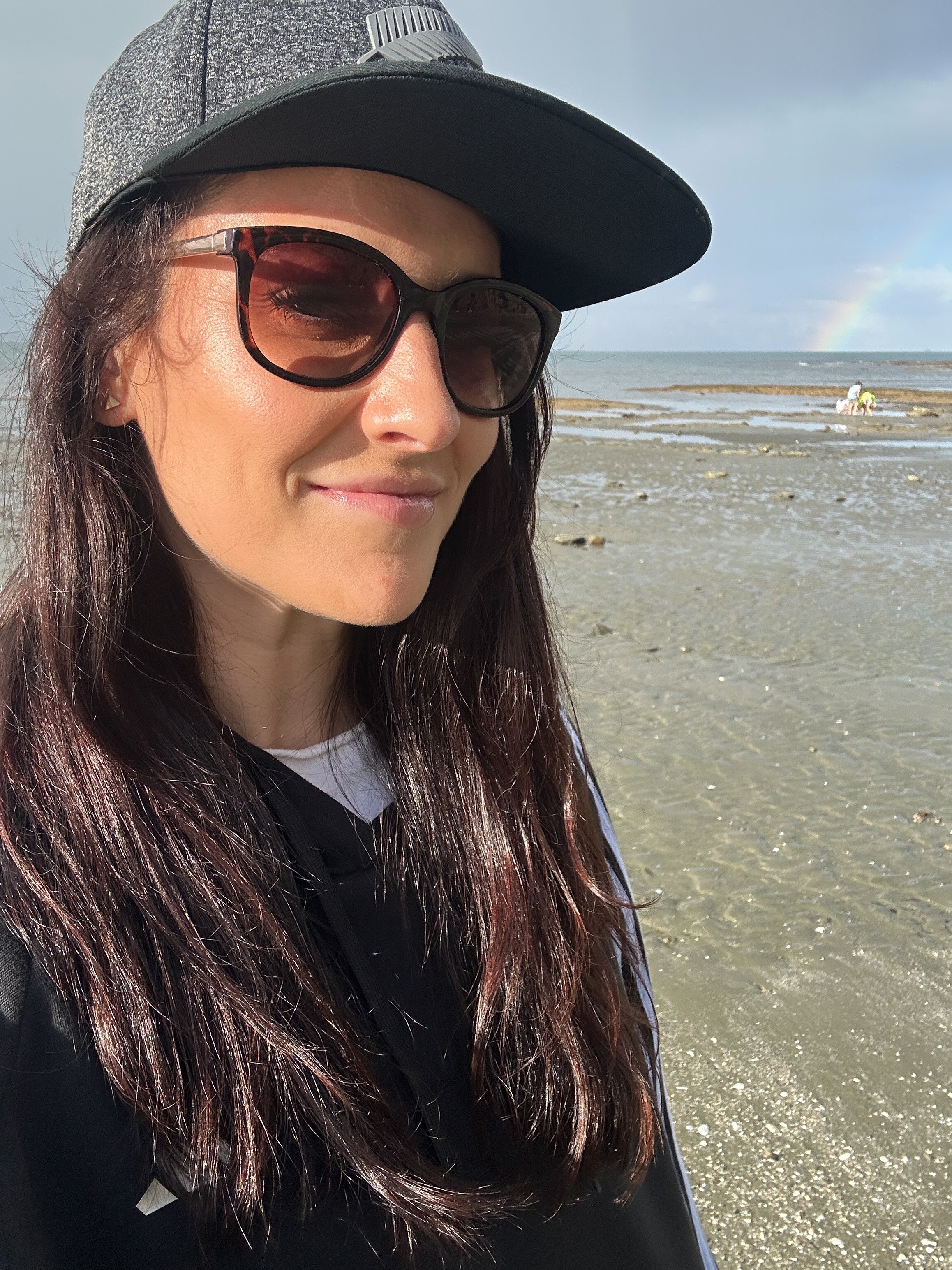
Wenderholm Beach, New Zealand
Thank you for reading these thoughts from a trauma therapist in the wild! I work with residents of MO, FL, and CO, as well as offering in-person trauma intensives for anyone who is able to travel. Find out more about my work at my website.
1. https://www.estherperel.com/blog/letters-from-esther-2-security-and-freedom